How AI Search Engines Are Rewriting the Rules of Online Visibility
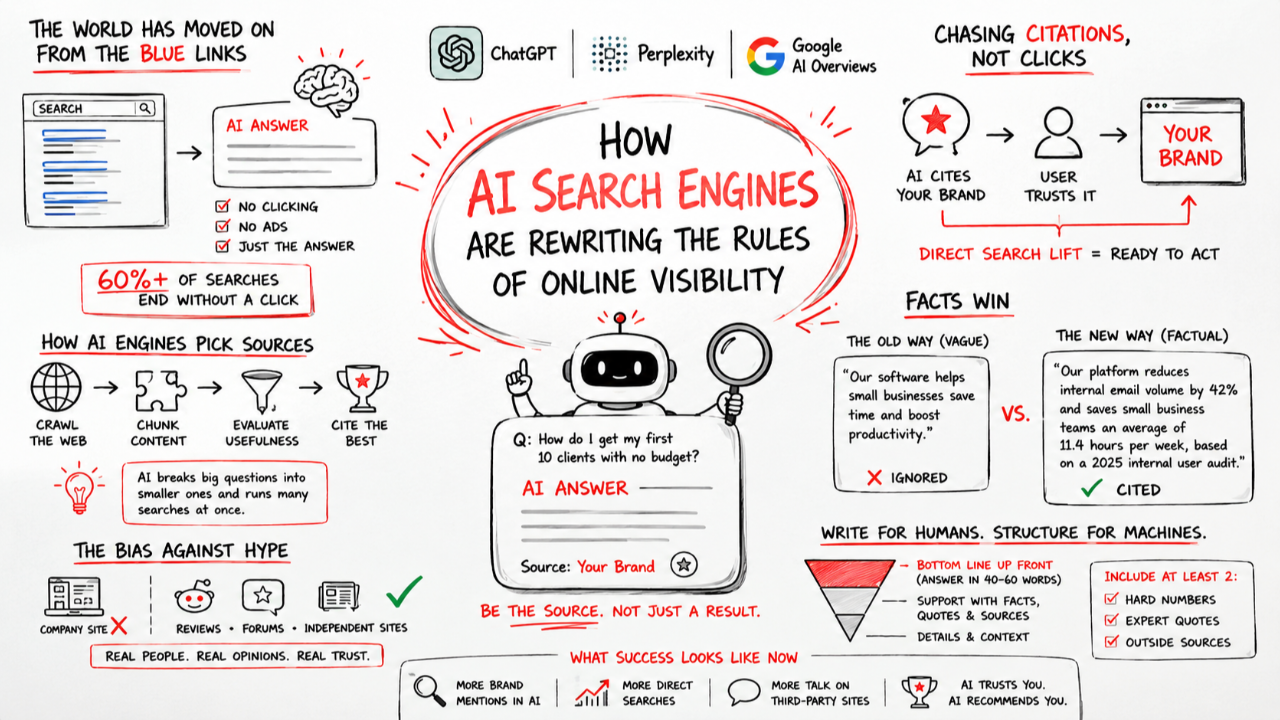
The old way of getting found online is fading fast. AI tools like ChatGPT, Perplexity, and Google's AI Overviews are changing how people search — and how businesses need to respond. More than 60% of searches now end without anyone clicking a single link. Instead, AI tools write out the answer directly. For brands that rely on web traffic, that's a serious problem. But for those who learn to work with AI, it may be the biggest opportunity in years.
The World Has Moved On From the Blue Links
For about two decades, the internet ran on a simple deal. Businesses created free content. Search engines sent them visitors in return.
That deal is over.
People today don't want to sort through ten links. They want a fast, clear answer. So they type detailed questions into AI tools and get a response in seconds.
No clicking. No pop-up ads. No cookie banners. Just the answer.
This shift has a name: the zero-click reality. More than 60% of searches now end right there, with no visit to any website at all.
If your business depends on people clicking your link, your traffic numbers are likely falling. That's not a glitch. It's the new normal.
Why AI Citations Are Worth More Than Old-School Clicks
Here's what's interesting: AI doesn't make up its answers. It pulls from real websites, reads real content, and often names its sources right inside the chat window.
That citation — your brand name, recommended by an AI — carries serious weight.
Think about it. A user has just asked a detailed question. The AI has done the research. And then it says: this company has the answer.
That user isn't a casual browser. They're ready to act. They often don't even click the citation link. Instead, they open a new tab and search directly for your brand name.
Experts call this "direct search lift." It's how some small, independent brands are growing without big advertising budgets.
A simple idea drives this new approach: instead of chasing traffic, chase citations.
How AI Engines Actually Pick Their Sources
To get recommended by AI, you need to understand how these tools think.
Traditional search engines ranked pages based on keywords and links. AI engines go much deeper. They read your content, break it into small pieces — called "chunks" — and judge how useful each piece is.
This process is called Retrieval-Augmented Generation. Think of it as a super-fast researcher who scans the web the moment someone asks a question, pulls the best pieces of information, and stitches them into one clean answer.
If your website is full of long, vague paragraphs with no clear facts, the AI skips you. It moves to a competitor whose content is easier to pull apart and use.
AI tools also handle complex questions by breaking them into smaller ones. A question like "How do I get my first ten clients with no budget?" gets split into several mini-searches running at the same time. Your content needs to answer those smaller, specific questions directly.
The Bias Against Hype — And What to Do Instead
Here's something that may surprise you: AI engines don't trust company websites very much.
They know a business will always say its own product is the best. So they look for outside proof. They scan forums, review sites, independent blogs, and community boards to see what real users say.
If your brand only shows up on your own website, the AI will likely ignore you. But if real people are talking about you on Reddit, rating you on review platforms, or mentioning you in independent articles, the AI takes notice.
This is how it builds what you might call a "confidence score" for each source. High confidence means a higher chance of being cited.
The takeaway? Your reputation across the whole internet matters — not just your own site.
Facts Beat Stories When It Comes to AI
Researchers from Princeton University, Georgia Tech, and the Allen Institute for AI studied what actually makes AI engines cite a website more often. They tested thousands of queries and dozens of content changes.
The results were clear. Old tricks like repeating keywords did almost nothing. In some cases, they actually hurt.
The one thing that worked? More facts.
By adding solid statistics, expert quotes, and real data points to existing content, websites saw their AI visibility jump by as much as 40%.
Why? Because AI tools are built to avoid getting things wrong. When they spot a hard number from a real study, it acts like a green light. It tells the machine: this source can be trusted.
Here's a side-by-side example of what this looks like in practice.
The old way: "Our software helps small businesses save time and boost productivity."
The new way: "Our platform reduces internal email volume by 42% and saves small business teams an average of 11.4 hours per week, based on a 2025 internal user audit."
The first sentence sounds nice. But an AI scraper gets nothing useful from it. The second sentence gives three solid data points the AI can actually extract and use.
Writing in a Way Machines Can Use
It's not just what you write — it's how you arrange it.
AI crawlers work inside tight limits. They want the core answer fast, without wading through long introductions.
The best approach is called the Inverted Pyramid, or Bottom Line Up Front. Put your direct answer in the very first 40 to 60 words of each section. No warm-up. No history lesson. Just the answer, right away.
Then follow it with your data, quotes, and outside sources. That structure lets the AI grab the summary quickly and use the facts to decide whether to trust you.
For each main section of your content, aim to include at least two of these three things:
- Hard numbers — percentages, dollar amounts, or time saved
- Expert quotes — real statements from recognized voices in your field
- Outside sources — references to studies, reports, or industry benchmarks
When your content is built this way, it becomes a reliable resource that AI engines keep coming back to.
What Success Looks Like Now — And What Comes Next
Stop watching your keyword rankings every morning. That number tells you less and less each month.
Instead, start noticing when your brand gets named inside AI answers. Track whether people are searching directly for your business name after seeing it in a chatbot response. Watch for mentions of your work on sites you don't control.
Those signals point to real momentum in the AI era.
The businesses that will win over the next few years aren't necessarily the biggest or the loudest. They're the ones the machines trust enough to recommend. Getting there means creating content that is specific, factual, and easy for AI to pull apart and use.
The formula is simpler than it sounds: say something real, back it up with numbers, and make it easy to find. Do that consistently, and the AI will start doing your marketing for you.
Stay connected with the most current Marketing News, Strategies, Tips , and Case Studies!
Join our monthly marketing magazine to receive the latest news and updates from our team of professional marketers and copywriters.
(Don't worry, your information will not be shared.)