Why Your Competitors' 5-Star Reviews Are Your Best SEO Asset
Why Your Competitors' 5-Star Reviews Are Your Best SEO Asset
By Damon Nelson | Published May 2026 | Reading time: ~7 minutes
Originally inspired by Mohit Vaswani's piece on Medium (Apr 2026)
Barry Allen — the fastest man alive — can outrun anything. He could cross the city in four seconds. The world went blurry and quiet at that speed. He could be anywhere before the thought of going there had fully finished.
Speed, in his experience, solved most problems. If you could always be there first, most things didn't get the chance to go wrong.
Then came the night of the Westside Bridge.
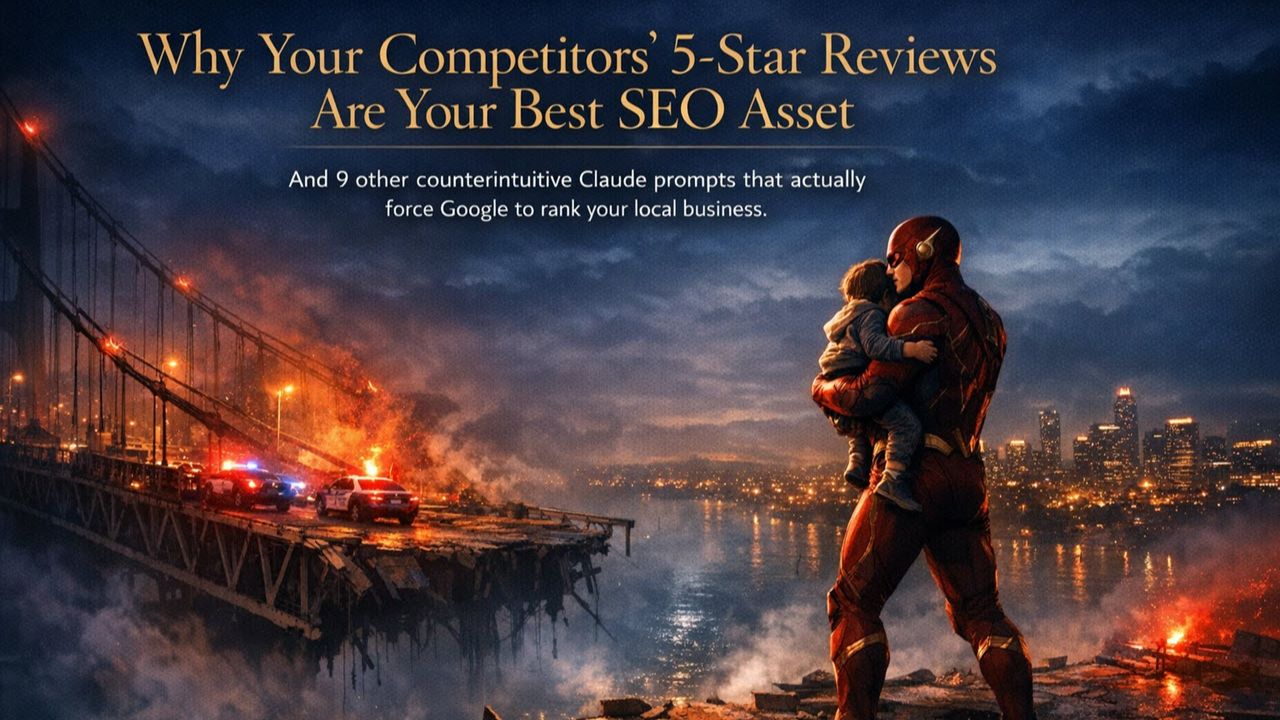
An earthquake cracked three of the bridge's support pillars. Cars dangled from guardrails. Barry was there in less than a second, pulling people back from the edge, his hands and feet moving faster than any camera could catch. He got almost everyone.
But one girl was missing. She was frozen on a tilted slab of concrete resting on nothing but a crushed car below. The slab shifted every time the wind moved. Barry assessed the physics in milliseconds. If he hit that slab at any appreciable speed, the vibration alone would knock it loose. He could not snatch her and be gone in a blur.
He had to go slowly.
He stepped onto the concrete at a careful, deliberate, ordinary human pace. He felt for the shift. He moved the way people move when they are carrying something fragile. The slab held. He knelt down very slowly, picked her up, and carried her back one careful step at a time.
When they reached solid ground, she looked up at him. "Are you the Flash? You were really slow."
"Yeah," he said. "That's the one thing I had to learn."
The Local SEO Trap
Most content marketers and solopreneurs treat Claude exactly like Barry treated his speed before the bridge. You log in, type a fast command, and ask it to sprint. "Write a 500-word blog post." "Give me 10 meta descriptions." "Draft a quick email."
It's fast. It feels productive. But you're basically buying a Ferrari to go grocery shopping.
You're frustrated because your local service pages are stuck on page 2. You're overwhelmed trying to figure out why a competitor with a worse website outranks you in the map pack. You're churning out more content, hoping volume will solve the problem. But moving faster in the wrong direction just gets you lost quicker.
The real win requires slowing down. It requires using Claude not as a fast typewriter, but as a precision competitive intelligence weapon.
The Extraction Technique
The secret to actually moving the needle on Google isn't asking Claude to write more. It's asking Claude to extract better.
Instead of generating generic SEO fluff, you feed Claude your competitors' live data—their reviews, their Google Business Profile (GBP) categories, their backlink profiles—and force it to find the gaps you are missing.
"Go to these competitor GBP listings: [URL1], [URL2], [URL3]. Read the last 100 reviews for each. Extract: the top 20 emotional words used most, the top 10 specific outcomes mentioned, the top 5 fears or frustrations mentioned before the service, and the exact phrases that appear in 5-star reviews but not in 3-star ones."
This shift in operating posture changes everything. You stop guessing what Google wants and start reverse-engineering what is already working.
| Without The Extraction Technique | With The Extraction Technique |
|---|---|
| Guessing which keywords to target | Mapping exact competitor GBP categories |
| Writing generic "professional service" copy | Using the exact emotional phrases from 5-star reviews |
| Blindly building random directory links | Replicating the exact backlinks top competitors share |
| Staring at Search Console wondering why you're stuck | Executing a precise 30-day sprint to fix Page 2 pages |
Why It Works When Others Don't
This works because Google doesn't rank "good writing." It ranks relevance, authority, and trust signals.
When you use Claude to write meta descriptions, you are trying to manufacture relevance out of thin air. When you use Claude to analyze the top 3 map pack competitors, extract the secondary categories they all share, and add them to your own profile, you are aligning perfectly with Google's established pattern of trust.
It's the difference between running fast and running smart.
5 Real-World Applications for Solopreneurs & Marketers
Here is how you actually deploy this precision strategy to reclaim your time, reduce your stress, and watch your rankings climb.
1. The Missing Map Pack Trigger
A local plumbing client is stuck on page 2 of the map pack for "emergency plumber," even though they offer 24/7 service.
The Prompt:
"Open Chrome and search ‘emergency plumber in Dallas’ for these 3 keywords: [emergency plumber], [24 hour plumber], [burst pipe repair]. For each search, open the top 3 map pack competitors and extract their primary and secondary GBP categories. Build a spreadsheet: business name, all categories, star rating, review count, ranking position. Highlight every category my competitors have that I’m missing."
What the AI surfaces: The obvious answer is that they all use "Plumber" as the primary category. But the hidden downside is that just being a "Plumber" doesn't trigger the emergency intent in Google's local algorithm. The less obvious alternative? Every top-ranking competitor also has "Water Damage Restoration Service" as a secondary category. The second-order effect is massive: adding that one secondary category unlocks a whole new cluster of emergency-intent searches without changing a single word of website copy.
2. The Review Sentiment Hijack
You're rewriting a client's homepage headline, but "Dallas's Premier HVAC Experts" isn't converting traffic into calls.
The Prompt:
"Go to these competitor GBP listings: [URL1], [URL2], [URL3]. Read the last 100 reviews for each. Extract: the top 20 emotional words used most, the top 10 specific outcomes mentioned, the top 5 fears or frustrations mentioned before the service, and the exact phrases that appear in 5-star reviews but not in 3-star ones."
What the AI surfaces: The obvious takeaway is that customers like technicians who are "professional" and "on time." The downside is that "professional" is table stakes; it doesn't overcome the underlying fear of getting ripped off. The AI reveals that 5-star reviews consistently use the phrases "didn't try to upsell me" and "explained it simply." You change the homepage headline to: "Expert HVAC Repair in Dallas. No confusing jargon. No aggressive upselling." Conversions double because you're finally answering their unstated fear.
3. The Page 2 Rescue Operation
Your site has dozens of blog posts sitting at position 14. You know they need "updating," but you don't know exactly what to change.
The Prompt:
"Log into Google Search Console for [mydomain.com]. Pull the last 90 days of data. Find every keyword where I rank between position 11 and 20 with at least 100 monthly impressions. For each: check if the keyword is in the title tag, H1, and first 100 words. Build a 30-day sprint... Write the exact copy for every single change."
What the AI surfaces: The obvious reaction is to build more backlinks or add 500 words of fluff content. The downside is that link building takes months, and fluff dilutes the page. Instead, the AI spots that the exact keyword isn't in the H1, and the title tag is getting truncated. Claude writes the exact replacement H1 and Title. A 5-minute title tag change bumps the page from position 14 to position 6 within a week, capturing traffic that was already there.
4. The Citation Trust Signal
A local roofing company moved offices two years ago. Their rankings have been slowly bleeding out ever since.
The Prompt:
"My exact business info: Name: [exact name], Address: [new address], Phone: [phone]. Search for my listing across: Yelp, Bing Places, Apple Maps, Facebook, BBB, Angi, Thumbtack. For each, record the name, address, phone, and URL exactly as listed. Flag every inconsistency and give me step-by-step instructions for correcting each one."
What the AI surfaces: The obvious fix is updating the address on Google Business Profile and hoping the rest follows. But Google cross-references trust signals. If Yelp and Apple Maps still show the old address, Google suppresses the listing due to conflicting data. The AI finds 14 different directories still showing the old address. Fixing those 14 citations removes the algorithmic penalty, restoring the trust signal and bringing the map pack rankings back to life.
5. The Competitor Backlink Blueprint
You know you need backlinks, but buying random guest posts feels risky, and cold outreach is exhausting.
The Prompt:
"In Ahrefs, pull the backlink profile for [competitor1], [competitor2], [competitor3] filtered to: dofollow only, DR 20+, referring domain traffic 100+/month. Find domains that link to all 3 competitors but not to me. For each one, tell me how the competitor likely earned the link, and write the full outreach email I can send today."
What the AI surfaces: The amateur move is emailing every site in their backlink profile. The reality is 90% of those links are paid, spammy, or impossible to replicate. Instead, the AI identifies 4 local community boards and industry associations that link to all three competitors. You send the AI-written outreach emails to those 4 highly relevant, attainable targets, securing links that actually move the needle instead of wasting time on hundreds of dead ends.
When to Use It and When to Skip It
Use this extraction framework when you are entering a new local market, auditing a stalled client site, or trying to push a page from position 12 to position 3. It is a surgical tool for competitive intelligence. Do NOT use this if you haven't established your core business details yet. If your website is completely blank, write your foundational content first before trying to reverse-engineer the competition.
The Deeper Lesson
Speed without awareness is just motion. Sometimes the most powerful thing you can do with any gift is know exactly when not to use it at full force.
When Barry Allen slowed down on that bridge, he wasn't abandoning his power; he was adapting it to the exact constraints of the problem in front of him. He realized that raw output wasn't the goal. Precision was.
The same is true for your content automation. Pumping out 50 generic blog posts a day using AI is just motion. It might feel like you're moving fast, but you're vibrating the bridge without saving the girl. When you slow down, feed Claude the right competitive data, and ask it to extract the precise gaps in your market, you build a durable advantage that outlasts any algorithm update.
Your Next Step
Stop guessing. Open Claude today, paste in your top three competitors' GBP URLs, and run the Review Sentiment Hijack prompt.
"Go to these competitor GBP listings... Extract the exact phrases that appear in 5-star reviews but not in 3-star ones."
Take those exact phrases and put them in your homepage headline. Feel that shift? That's what happens when you stop acting like a typist and start acting like a strategist. Next, we'll scale it.
Did this extraction technique change how you think about using Claude for SEO? Drop a comment below and share which of the 5 prompts you are going to run first.
This article was inspired by Mohit Vaswani's original piece, "10 Claude Prompts That Actually Rank You on Google," published Apr 2026 on Medium. [1]
References
[1] Mohit Vaswani. "10 Claude Prompts That Actually Rank You on Google." Medium, Apr 2026. https://medium.com/@hii_mohit/10-claude-prompts-that-actually-rank-you-on-google-cbcf055a783d
About the Author: Damon Nelson has spent the last two decades helping online entrepreneurs cut through the noise of marketing automation and actually build recurring income systems — without a big team, without a massive budget, and without reinventing the wheel every time. He's the creator of popular SaaS tools including MarketMasher, RSSMasher, AIMasher, Article2Video, and BookMasher. He also hosts GeekOutFridays — a bi-weekly marketing automation show now in its sixth season, where he breaks down exactly what's working in AI and automation in plain English you can put to use the same week. If you want real strategies, real tools, and someone who has already figured out the system, you're in the right place.
Stay connected with the most current Marketing News, Strategies, Tips , and Case Studies!
Join our monthly marketing magazine to receive the latest news and updates from our team of professional marketers and copywriters.
(Don't worry, your information will not be shared.)