The Odysseus Protocol: How to Survive the Monday Morning Sirens
The Odysseus Protocol: How to Survive the Monday Morning Sirens
By Damon Nelson | Published May 2026 | Reading time: ~10 minutes
Originally inspired by Zack Liu's piece, "The 'Sunday Anchor' Concept: A Simple $9/Month Solution for Overwhelmed Pros," published April 2026 on Medium.
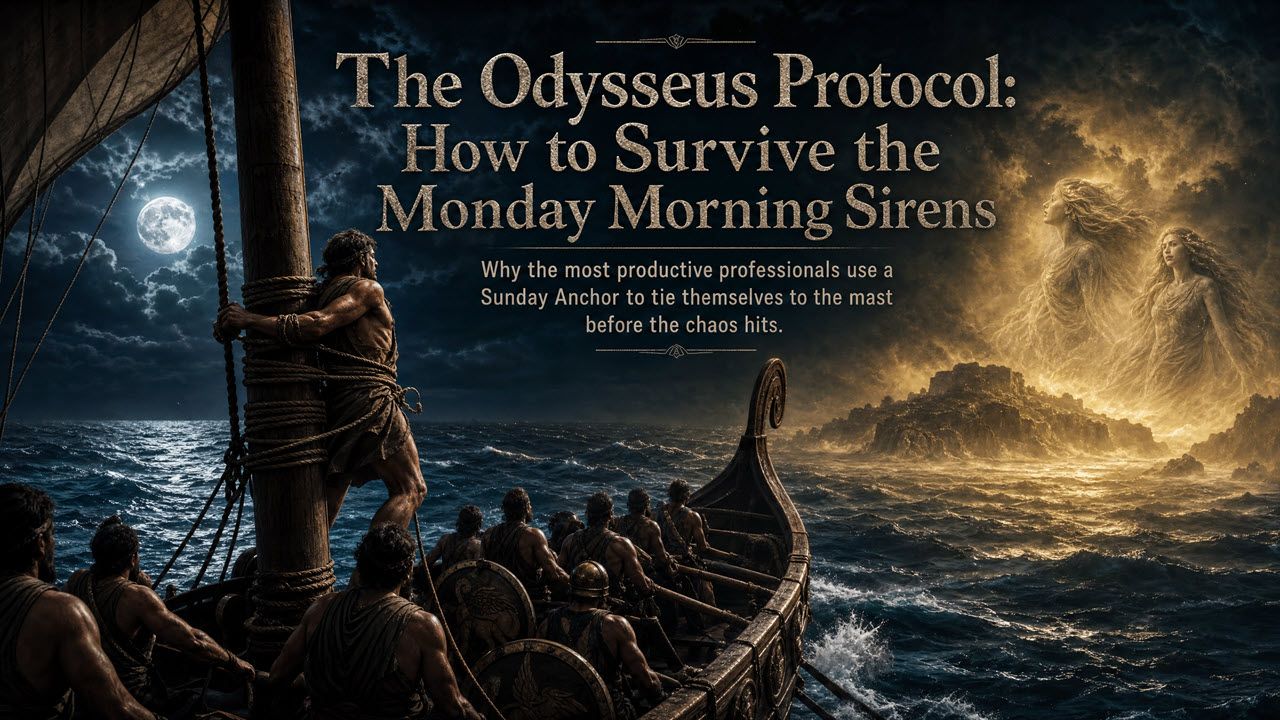
The Aegean Sea stretched before Odysseus like a canvas of sapphire and emerald, the sun casting a shimmering path across the water. But a chill — not of the wind — ran through the hearts of his men. They knew what lay ahead. The Sirens.
Those enchanting voices had lured countless sailors to their deaths on the jagged rocks below. Not through brute force. Not through deception. Through something far more dangerous: the promise of exactly what each man most desperately wanted.
Odysseus understood something his crew did not. The enemy was not the Sirens. The enemy was the unprotected mind encountering them without a system in place.
So he built one. He ordered beeswax pressed into every man's ears. And for himself — the one man who would hear the song — he had his crew lash him to the mast with orders to hold fast no matter what he said, no matter how loudly he commanded them to let him go.
He designed his constraint before the chaos arrived.
The ship passed the island. The song came. Odysseus strained against the ropes, pleaded, raged. The crew held. When the last echo faded and the madness receded, he stood exhausted but unbroken — the only man in history to hear the Sirens and survive.
Here is what no one talks about in that story: the real act of courage was not surviving the song. It was the decision he made the night before, when the sea was still calm and the temptation was still theoretical.
That is the Sunday Anchor.
The Problem Has a Name: Priority Dilution
You already know the feeling. It is 10:47 PM on a Sunday and you are staring at your phone, running through the week ahead like a loop you cannot stop. The inbox. The client who needs a response. The project that slipped. The three things you promised yourself you would start on Monday.
By the time Monday morning arrives, you are already exhausted from a week that has not even started yet.
This is not a discipline problem. It is not a motivation problem. It is a structural problem — and it has a name. Zack Liu, writing on Medium in April 2026, called it Priority Dilution: the silent killer of professional performance that occurs when you have 200 tasks and zero clarity about which three actually matter.[^1]
The cruel irony is that the harder you work, the worse it gets. More clients means more messages. More success means more obligations. More ambition means more open loops spinning in the background of your mind at 11 PM on a Sunday when you should be resting.
You are not failing because you lack effort. You are failing because no one ever gave you a filter.
The Sunday Anchor: What It Actually Is
The Sunday Anchor is not a productivity app. It is not a new dashboard to manage, a calendar to sync, or a leaderboard to compete on. It is something far more valuable and far more rare.
It is a cognitive offloading loop — a system that receives the weight of your anxiety on Sunday night and hands you back a clear, prioritized plan before Monday morning begins.
The mechanism is simple. On Sunday evening, you answer three focused reflection questions. What were your wins last week? What is the one thing that must happen this week for it to feel like a success? What is the single biggest obstacle standing between you and that outcome?
The system processes those answers and delivers a curated action plan directly to your phone — via SMS or WhatsApp — before you open your email on Monday morning.
"The most valuable product in an overstimulated world is the one that tells the user exactly what to ignore." — Zack Liu[^1]
That is the shift. You are not adding another tool to your stack. You are installing a Strategic Filter that stands between you and the Monday Morning Fog — the reactive, inbox-defense mode that burns the first four hours of your week on everyone else's fire drills.
| Without the Sunday Anchor | With the Sunday Anchor |
|---|---|
| Reactive inbox management from 8–11 AM | Three clear priorities waiting on your lock screen |
| Decision fatigue before the first meeting | Mental energy reserved for deep, revenue-generating work |
| Sunday night anxiety loop | Sunday night closure and a sense of preparedness |
| Scattered effort across 20 tasks | Focused execution on the one thing that moves the needle |
| High churn on productivity tools | A relationship with a system that learns your patterns |
The difference is not just efficiency. It is the emotional experience of your Monday morning. And that experience — the feeling of being "on top of it" before the week even starts — is worth considerably more than $9 a month to the professional who has been living without it.
Why Ruthless Simplicity Is the Real Product
Here is where most builders — and most professionals — go wrong. They confuse complexity with value.
The enterprise tools are built for companies. They are designed so managers can track workers. They were never built for the individual's mental health or their capacity for focused work. Notion is powerful. Asana is comprehensive. Neither one will send you a text message on Monday morning that feels like an elite executive coach whispering in your ear.
The Sunday Anchor wins precisely because it does less. No dashboard to log into. No calendar sync to configure. No social features, no leaderboards, no complex onboarding. If it takes more than 60 seconds to set up, the user quits before they ever experience the value.
This is the Feature Kill List principle in action — the counterintuitive discipline of removing everything that does not directly serve the user's core emotional need.[^1] And that need is not "more organization." It is the end of the Sunday Scaries and the beginning of a Flow State Monday.
I watched a colleague of mine — a freelance developer with three active clients — spend six months trying every productivity tool on the market. Notion, Todoist, ClickUp, a custom Airtable setup that took him two weekends to build. Each one added complexity. Each one required maintenance. Each one quietly became another source of anxiety. When he finally stripped everything back to a single Sunday reflection form and a Monday morning text message, he told me the relief was almost physical. He said it felt like putting down a backpack he had forgotten he was wearing.
That is the product. Not the features. The relief.
5 Real-World Applications for Overwhelmed Professionals
1. The Real Estate Agent Drowning in "Urgent" Requests
A high-earning realtor has 14 text messages from clients sitting in her phone on Sunday night. Without a filter, Monday morning will be consumed entirely by reactive problem-solving instead of closing new deals.
The Sunday Anchor Prompt:
"Act as my Sunday Anchor. Here are the 14 tasks and messages on my plate right now. Filter them through the lens of 'Revenue Generation' vs. 'Administrative Noise.' Tell me the 3 things I must do tomorrow morning to move the needle, and exactly what I can ignore or delegate."
What the system surfaces:
The obvious answer is to reply to all 14 texts immediately — but that trains clients to expect 24/7 availability and quietly destroys the focused deal-making time that actually generates income. The less obvious alternative is to identify the 2 texts tied to active negotiations, flag them for 9 AM Monday, and let the rest wait until Tuesday. The second-order effect is significant: clients learn to respect her time, her Monday mornings become protected, and her closing rate improves because she is operating from strategy instead of reaction.
2. The Freelance Designer Paralyzed by Scope Creep
A freelance designer has four active projects, all with creeping scope. Sunday night is spent calculating which client will be the most upset on Monday morning — a calculation that produces nothing useful and costs hours of sleep.
The Sunday Anchor Prompt:
"Act as my Sunday Anchor. Here are my 4 active projects and the current demands from each client. Filter this through the lens of 'Contractual Obligation' vs. 'Scope Creep.' Tell me the single most important milestone to hit for each tomorrow, and which demands I need to push back on."
What the system surfaces:
The obvious move is to do a little work on all four projects to show progress everywhere. The hidden downside is microscopic movement on every front, which frustrates all four clients and exhausts the designer by Wednesday. The anchor identifies the one project closest to completion, recommends finishing it by noon Monday, and drafts boundary-setting language for the other three. The emotional payoff is a quick win, a dopamine hit of completion, and the restored sense of being in control of the week rather than managed by it.
3. The Solo-Founder Chasing Too Many Features
A solo-founder has a list of 20 new features they are convinced they need to build. Sunday night is spent staring at a Figma file, overwhelmed by the sheer volume of work and the paralysis of not knowing where to start.
The Sunday Anchor Prompt:
"Act as my Sunday Anchor. Here is my list of 20 feature ideas. Filter them through the lens of 'Immediate Revenue Impact' vs. 'Nice-to-Have.' Tell me the one feature I should focus on building this week, and give me permission to ignore the other 19."
What the system surfaces:
The obvious answer is to start with the easiest feature to feel productive. The hidden downside is a week spent building something no paying user asked for, while actual retention problems go unsolved. The anchor surfaces the one feature that directly addresses a pain point from current paying users — and explicitly deprioritizes everything else. The second-order effect is increased MRR and reduced churn, because the founder is solving real problems instead of building for the sake of building.
4. The Marketing Agency Owner Managing Team Chaos
An agency owner has a team of five, all working on different client accounts. Sunday night is spent wondering whether the team is actually aligned or just busy — and whether "busy" is going to translate into results or into a difficult client call on Friday.
The Sunday Anchor Prompt:
"Act as my Sunday Anchor. Here are the 5 major client campaigns running this week. Filter them through the lens of 'Client ROI' vs. 'Busy Work.' Tell me the one specific metric each team member needs to hit by Friday, and what I should tell them to stop doing."
What the system surfaces:
The obvious move is a two-hour all-hands meeting on Monday morning to align everyone. The hidden cost is ten collective hours of productive time spent talking about work instead of doing it. The anchor produces a concise Slack message — ready to send Sunday night — with one clear objective per person and explicit permission to cancel the Monday meeting. The team starts Monday with extreme clarity, executing immediately instead of waiting for direction. The agency owner starts Monday with her own focused work, rather than facilitating a meeting that could have been a message.
5. The Content Creator on the Hamster Wheel
A content creator feels the pressure to post on five different platforms every day. Sunday night is spent in a low-grade panic about what to write for the week, a panic that produces nothing except the vague sense that Monday will be chaotic.
The Sunday Anchor Prompt:
"Act as my Sunday Anchor. Here are the 5 platforms I'm trying to manage. Filter them through the lens of 'Highest Engagement' vs. 'Energy Drain.' Tell me the one piece of pillar content I should create tomorrow, and how to slice it for the rest of the week so I don't have to create from scratch every day."
What the system surfaces:
The obvious answer is to write five unique posts for Monday morning. The hidden downside is burnout by Wednesday and mediocre content across all platforms. The anchor identifies the one platform where the creator's audience is most engaged, recommends one high-quality long-form piece on Monday morning, and maps out how to extract ten social posts from it for the rest of the week. The second-order effect is a sustainable content engine that actually grows an audience — without the Sunday night panic that was quietly eroding the creator's love for the work.
When to Use It and When to Skip It
The Sunday Anchor is most powerful for professionals who operate with high autonomy and low external structure — realtors, freelancers, solo-founders, agency owners, content creators, and anyone else who starts Monday morning without a manager telling them exactly what to do. If your primary challenge is deciding what to work on rather than how to do the work, this system was built for you.
It is less useful if your week is already fully structured by external commitments — back-to-back meetings, a rigid project management system enforced by a team, or a role where your daily priorities are handed to you by someone else. In those cases, the bottleneck is not clarity; it is capacity, and a different kind of solution applies.
The Deeper Lesson: What Odysseus Actually Taught Us
Here is the second moral of the Odysseus story — the one that gets overlooked in every retelling.
The ropes did not save him. His crew did not save him. His own intelligence and cunning, formidable as they were, did not save him either. What saved him was the decision he made before the Sirens' song began, when the sea was calm and his mind was clear and the temptation was still theoretical.
He understood that his future self — the self who would hear that song — could not be trusted to make the right decision in the moment. So his present self, the calm and rational one, built a system that would protect him from his own worst impulses.
That is the Sunday Anchor. Not a productivity hack. Not a new app. A decision made on Sunday night, when you are calm and clear, that protects Monday-morning-you from the Sirens of the inbox, the urgent-but-not-important requests, the reactive fog that consumes the first hours of the week.
The professionals who consistently outperform their peers are not the ones with the most discipline in the moment. They are the ones who build the right constraints in advance. They tie themselves to the mast before the song starts.
"Retention isn't about how many features you have; it's about how much anxiety you remove from the user's life." — Zack Liu[^1]
That quote is about building a SaaS product. But it is equally true about building a week. The Sunday Anchor removes anxiety from your Monday morning. That removal — that specific, measurable reduction in the cognitive weight you carry into the first hours of the week — compounds over time into something that looks a lot like freedom.
Your Next Step
The Sunday Anchor is not complicated to implement. You do not need a $9/month app to start. You need three questions, answered honestly, on Sunday night.
What was my biggest win last week? What is the one outcome that would make this week a success? What is the single biggest obstacle between me and that outcome?
Write the answers down. Put them somewhere you will see them before you open your email on Monday morning. That is the mast. That is the constraint. That is the system that stands between you and the Sirens.
Once you have experienced one Monday morning where you wake up knowing exactly what matters — and exactly what to ignore — you will not go back. The clarity is that good. The relief is that real.
[Click here to read the full technical blueprint for building the Sunday Anchor as a $9/month Micro-SaaS]
Did this change how you think about the Sunday night anxiety loop? Drop a comment below and share the one thing that consistently derails your Monday morning focus — let's see if the Sunday Anchor can solve it.
This article was inspired by Zack Liu's original piece, "The 'Sunday Anchor' Concept: A Simple $9/Month Solution for Overwhelmed Pros," published April 2026 on Medium.
About the Author: Damon Nelson has spent the last two decades helping online entrepreneurs cut through the noise of marketing automation and actually build recurring income systems — without a big team, without a massive budget, and without reinventing the wheel every time. He's the creator of popular SaaS tools including MarketMasher, RSSMasher, AIMasher, Article2Video, and BookMasher. He also hosts GeekOutFridays — a bi-weekly marketing automation show now in its sixth season, where he breaks down exactly what's working in AI and automation in plain English you can put to use the same week. If you want real strategies, real tools, and someone who has already figured out the system, you're in the right place.
[^1]: Zack Liu, "The 'Sunday Anchor' Concept: A Simple $9/Month Solution for Overwhelmed Pros," Medium, April 2026.
Stay connected with the most current Marketing News, Strategies, Tips , and Case Studies!
Join our monthly marketing magazine to receive the latest news and updates from our team of professional marketers and copywriters.
(Don't worry, your information will not be shared.)