Stop Trying to Build the Next Big App
Stop Trying to Build the Next Big App
By Damon Nelson | Published May 5, 2026 | Reading time: ~7 minutes
Originally inspired by Zack Liu's piece on Medium (Apr 22, 2026)
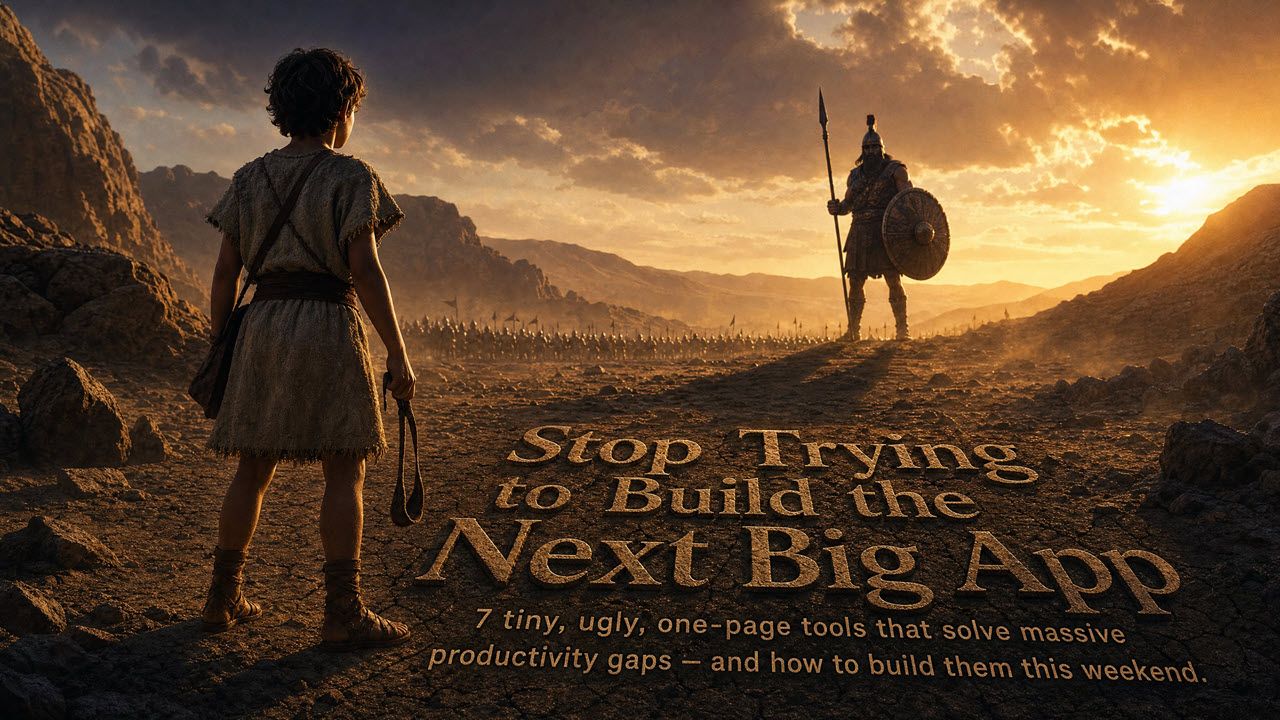
In the sun-baked valley of Elah, two armies stood poised for battle. On one side, the Philistines, a formidable force anchored by a champion whose very presence cast a shadow of dread. On the other, the Israelites, their courage faltering before the monstrous, nine-foot figure of Goliath.
For forty days, Goliath taunted the Israelite army, his booming voice chipping away at the resolve of King Saul's finest warriors. No man dared to face him. To step onto that field seemed a certain path to oblivion.
Then a young shepherd named David arrived. Seeing the paralyzing fear gripping the army, he volunteered. King Saul, desperate, offered David his own heavy, intricate armor. David put it on, felt the weight of it restricting his movement, and quickly cast it aside. He was not a man of war, but a shepherd. He would face this giant with the tools he knew.
David walked to a nearby stream, selected five smooth stones, and pulled out his sling. As he approached, the giant roared with laughter at the boy's lack of conventional weaponry. But David ran forward, whirled the sling with practiced precision, and let a single stone fly. It struck Goliath squarely on the forehead. The giant stumbled and crashed to the ground. The battle was over in seconds.
The right tool in the right hands beats brute force every time.
The "Goliath" Trap in Software
If you're an entrepreneur, a creator, or an agency owner right now, you are probably facing your own Goliath.
It’s the overwhelming, soul-crushing weight of "The Next Big Thing." You see the SaaS graveyard filled with founders who spent two years and a quarter-million dollars trying to build a sprawling, 50-feature platform to rival Salesforce or Asana. You feel the pressure to build something massive just to be taken seriously.
And while you're agonizing over complex wireframes and hiring developers, your actual business is bleeding out. You're losing hours every week to the "Prep Tax" of manual data entry. You're suffering from the "Focus Tax" of checking your inbox every six minutes. You're leaking willpower before 11:00 AM just deciding what task to tackle first.
The problem isn't that you lack vision. The problem is you're putting on King Saul's heavy armor when all you need is a sling.
You don't need a 50-person engineering team to build a profitable business or reclaim your time. You need to solve one specific pain point for one specific person.
The "Tiny SaaS" Sling
Enter the Micro-SaaS. A focused, high-utility tool—often built with no-code platforms or simple API connections—that people happily pay $20 a month for because it saves them five hours of pure frustration.
Zack Liu recently outlined this perfectly. The market doesn't need more sprawling platforms. It needs surgical interventions.
"Be the person who builds a 'Tiny SaaS.' A focused, high-utility tool that people happily pay $20/month for because it saves them 5 hours of frustration."
This shift in posture changes everything about how you operate:
| Without the Tiny SaaS Mindset | With the Tiny SaaS Mindset |
|---|---|
| You try to build a massive, all-in-one platform. | You build a one-page tool that does exactly one thing flawlessly. |
| You spend months agonizing over features and UI. | You launch a functional MVP in 48 hours using Bubble or Make.com. |
| You try to appeal to every possible user. | You target a hyper-specific niche (e.g., med students studying for boards). |
| You get paralyzed by the scope of the project. | You execute small, atomic steps that compound into massive time savings. |
Why the Sling Works When the Armor Fails
The Tiny SaaS model works because it attacks friction, not features.
When a developer is interrupted, it takes 23 minutes to return to deep focus. That's a "Focus Tax" that destroys profitability. A sprawling project management tool doesn't fix that; a simple voice-note Chrome extension that captures their mental state does.
You aren't selling software. You are selling Time Recovery. You are selling Focus-as-a-Service. You are selling a Willpower Insurance Policy.
When you narrow your focus to eliminating one specific cognitive or workflow tax, you stop competing with the giants and start dominating the niches.
5 Real-World Applications for Solopreneurs and Agencies
Let's look at how this Tiny SaaS mindset solves massive productivity gaps in the real world.
1. The Agency Onboarding Bottleneck
You run a marketing agency. Every time you sign a new client, you lose four hours manually transferring data from Typeform into Asana, Slack, and Google Drive folders.
The Tiny SaaS Fix:
"A simple Make.com automation triggered by the form submission that provisions the entire workspace in 3 seconds."
What the shift surfaces: The obvious answer is to hire a virtual assistant for data entry. But the hidden downside is that VAs make typos, get sick, and add ongoing payroll overhead. The less obvious alternative is building an internal Micro-SaaS that handles it instantly. The second-order effect? You reclaim 16 hours a month, redirecting that energy to closing high-ticket deals instead of organizing folders.
2. The Content Creator's "Dead Asset" Problem
You have 100 past YouTube videos with incredible hooks, but zero written content for LinkedIn or your newsletter because you don't have the time to transcribe and rewrite them.
The Tiny SaaS Fix:
"A Whisper API + Claude script that watches old videos and extracts 3 text posts per video, texting you one every morning."
What the shift surfaces: The obvious answer is to sit down every Sunday and manually write posts from memory. The hidden downside is you stare at a blank page, experience severe decision fatigue, and eventually give up. The less obvious alternative is a private "Boredom Bot" that drip-feeds your own brilliance back to you. The second-order effect? You build a massive written audience on autopilot without ever facing the blank page again.
3. The Consultant's Proposal Paralysis
You're a high-ticket consultant who spends three days agonizing over custom proposal PDFs for every prospect, drastically delaying the sales cycle.
The Tiny SaaS Fix:
"A Bubble.io form connected to a document generator. Input 5 variables, and the system locks the design and emails the PDF instantly."
What the shift surfaces: The obvious answer is to keep tweaking your Canva template until it looks "perfect." The hidden downside is the prospect cools off while waiting, and you lose the momentum of the sales call. The less obvious alternative is a "Decision Dice" constraint that removes your ability to overthink. The second-order effect? You close deals while the prospect is still emotionally hot, doubling your conversion rate.
4. The Course Creator's Support Nightmare
You spend two hours every single day answering the exact same login and module questions in your private Facebook group.
The Tiny SaaS Fix:
"A custom ChatGPT Assistant trained strictly on the course FAQs and transcriptions that intercepts questions and answers them instantly."
What the shift surfaces: The obvious answer is to hire a community manager to monitor the group 24/7. The hidden downside is margin erosion and the stress of managing another human being. The less obvious alternative is a "Memory Pipe" bot that handles the repetitive noise and only tags you for new, complex issues. The second-order effect? Students get instant gratification, refund rates drop, and you reclaim your mornings.
5. The E-commerce Founder's Inventory Panic
You're a dropshipper constantly switching tabs between Shopify, supplier emails, and ad dashboards, losing the mental thread of profitability in a sea of data.
The Tiny SaaS Fix:
"A Twilio SMS bot that pulls the 3 most critical numbers and sends a single 'Daily Battle Plan' text at 8:00 AM."
What the shift surfaces: The obvious answer is to buy a massive, complex dashboard software like Tableau. The hidden downside is you spend more time configuring the dashboard than actually selling products. The less obvious alternative is the "Sunday Anchor" approach—getting only the data that matters, pushed directly to your phone. The second-order effect? You start your day on offense, making strategic decisions instead of reacting to fifty open tabs.
When to Use It and When to Skip It
Use the Tiny SaaS approach when you have a highly specific, repetitive task that drains your energy, willpower, or time. It is perfect for bridging the gap between two existing platforms or automating a painful data-entry chore.
Skip it if the problem requires deep human empathy, complex subjective judgment, or if you are trying to build a feature-heavy ecosystem. Don't try to build the next Facebook with a Make.com integration.
The Deeper Lesson of the Sling
When David walked onto that battlefield, he didn't just win because he had a ranged weapon. He won because he refused to play Goliath's game.
Goliath expected a sword fight. He expected brute force. David understood that his strength lay in his agility, his precision, and his willingness to use a tool that the giant fundamentally misunderstood.
When you stop trying to build massive, bloated software and start focusing on tiny, surgical solutions, you are refusing to play the enterprise game. You are choosing the sling. And in the modern digital economy, the sling is what buys back your freedom.
Your Next Step
Stop staring at the mountain. Stop planning the 50-feature app.
Pick one specific, painful bottleneck in your workflow today. Build a "Smoke Test" landing page or a simple automation circuit this weekend. Ask yourself: "What is the absolute smallest tool I can build that will save me or my client two hours this week?"
Feel that shift in perspective? Next, we'll scale it.
Did this approach change how you think about building tools and saving time? Drop a comment below and tell me: What is the one repetitive task you are going to eliminate with a Tiny SaaS this weekend?
This article was inspired by Zack Liu's original piece, "7 Tiny SaaS Ideas That Solve Massive Productivity Gaps (and How to Build Them)," published Apr 22, 2026 on Medium.
About the Author: Damon Nelson has spent the last two decades helping online entrepreneurs cut through the noise of marketing automation and actually build recurring income systems — without a big team, without a massive budget, and without reinventing the wheel every time. He's the creator of popular SaaS tools including MarketMasher, RSSMasher, AIMasher, Article2Video, and BookMasher. He also hosts GeekOutFridays — a bi-weekly marketing automation show now in its sixth season, where he breaks down exactly what's working in AI and automation in plain English you can put to use the same week. If you want real strategies, real tools, and someone who has already figured out the system, you're in the right place.
Stay connected with the most current Marketing News, Strategies, Tips , and Case Studies!
Join our monthly marketing magazine to receive the latest news and updates from our team of professional marketers and copywriters.
(Don't worry, your information will not be shared.)